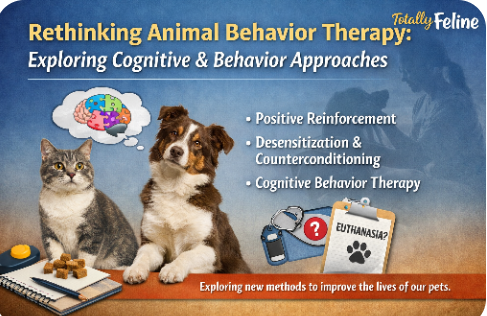
Expanding the Behavior Toolbox
Expanding the Behavior Toolbox: Conditioning, Counterconditioning, and Cognitive Behavioral Therapy in Animal Training
At Totally Feline, our work is grounded in compassion, science, and a deep respect for the emotional lives of animals. Like many animal trainers and behavior consultants, my professional foundation began with desensitization, counterconditioning, and positive reinforcement—methods widely recognized as humane, effective, and non-aversive. These approaches remain essential tools in my practice. Yet, as my experience has grown, so has my curiosity about what else might be possible when these tools alone are not enough.
The Foundation: Positive Reinforcement, Desensitization, and Counterconditioning
Positive reinforcement focuses on increasing desirable behaviors by rewarding them—food, play, praise, or access to preferred resources. It builds trust, strengthens the human–animal bond, and empowers animals to make confident choices.
Desensitization works by gradually exposing an animal to a trigger at a low intensity, below the threshold that causes fear or reactivity, and slowly increasing exposure over time.
Counterconditioning goes a step further by changing the animal’s emotional response to a trigger. For example, pairing a previously frightening stimulus with something positive—like a favorite treat—can shift fear into anticipation or neutrality.
These methods are evidence-based and widely supported by leading professionals in the animal behavior field. They are often the first—and best—line of support for many behavior challenges.
When Traditional Methods Aren’t Enough
Over time, I began to notice a difficult reality: while conditioning-based methods are powerful, they do not always resolve complex or severe behavior issues. In some cases, animals continue to struggle despite consistent, ethical application of desensitization and counterconditioning.
This realization led me to explore whether other complementary methodologies could exist within a non-aversive framework.
As a former Early Childhood Educator, I was trained to recognize that no single educational model works for every child. We adapt approaches based on learning styles, emotional development, and individual needs. This raised an important question for me:
If we accept multiple evidence-based approaches for teaching children, why are we so hesitant to explore additional humane approaches for animals?
Discovering Cognitive Behavioral Therapy for Animals
My interest deepened when I was introduced to Canine Cognitive Behavioral Therapy (CCBT) through the work of Billie Groom and the Institute of Canine Cognitive Behavioral Therapy. While Cognitive Behavioral Therapy (CBT) is well known in human psychology—particularly for supporting adults and children with anxiety and depression—I had never fully considered its application to animals.
What immediately stood out was this: CBT-based approaches explicitly acknowledge the animal’s emotional state, not just the observable behavior.
Rather than focusing solely on changing responses through repeated conditioning, cognitive behavioral approaches aim to:
- Identify emotional patterns driving behavior
- Reduce chronic stress and emotional overload
- Help the animal develop new coping strategies
- Address the why behind the behavior, not just the what
A Question That Still Haunts Me
Recently, a dog I read about online was euthanized at a no-kill shelter due to idiopathic aggression. The shelter followed standard protocols rooted in desensitization and conditioning. Despite their efforts, the behavior did not improve.
This left me asking a difficult but necessary question:
If a cognitive behavioral approach had been available and applied, could this dog’s outcome have been different?
As Billie Groom has shared, far too many dogs are euthanized for behavior-related concerns—not because people failed to care, but because the methodology being used did not reach the root of the problem.
Why We Need a Broader, Ethical Toolbox
When pet parents become overwhelmed and trainers feel limited by a single framework, animals are the ones who ultimately pay the price. Exploring additional, ethical, non-aversive methodologies should not be seen as a rejection of positive reinforcement—but as an expansion of it.
At Totally Feline, we believe:
- Animals are emotional beings
- Behavior is communication
- One size does not fit all
- Curiosity and continued education save lives
What This Means for Cats—and the Future of Totally Feline
Cat behavior resources are already limited compared to those available for dogs. Throughout my career, I have often adapted dog-based behavior science to meet feline needs—carefully, thoughtfully, and with respect for species differences.
If cognitive behavioral therapy can help dogs regulate emotions and reduce severe behavior challenges, I believe it holds potential for felines as well.
I’ll be honest: I am still learning. I don’t yet fully understand how cognitive behavioral concepts translate across species. Coming from a strong background in conditioning, desensitization, and counterconditioning, it has been challenging—but meaningful—to explore these connections.
Growth often begins with discomfort.
Moving Forward
Totally Feline is both a professional practice and a personal journey. As our understanding of animal behavior evolves, so must our willingness to learn, question, and adapt.
By honoring positive reinforcement while remaining open to emerging, compassionate methodologies like cognitive behavioral therapy, we create more opportunities for animals to heal, thrive, and—most importantly—stay alive.
Because every animal deserves more than one chance—and more than one approach.
---
About the Author
Dee A. K. is the founder of Totally Feline, a cat-focused brand centered on compassionate education, advocacy, and community connection. Certified Cat Trainer with over 13 years of professional, personal, and volunteer experience, Dee blends positive reinforcement, humane training, and a deep respect for animal emotional well-being—especially for cats.
Gentle Disclaimer
This content is for educational purposes only and is not a substitute for veterinary care or individualized behavior consultation. Animal behavior approaches continue to evolve, and all concerns should be addressed with qualified professionals using evidence-based, humane, and non-aversive methods.
For more information on Canine Cognitive Behavior Therapy go to Billie Groom’s website https://www.upwarddogology.com